ServicesFurnace Repair
Furnace Repair in Rosalia
When your furnace stops heating, we find the exact part that failed, tell you why it failed and give you a written quote before any work begins. Our service is available 24/7, with no emergency or after-hours fees on a cold night.
What furnace repair covers
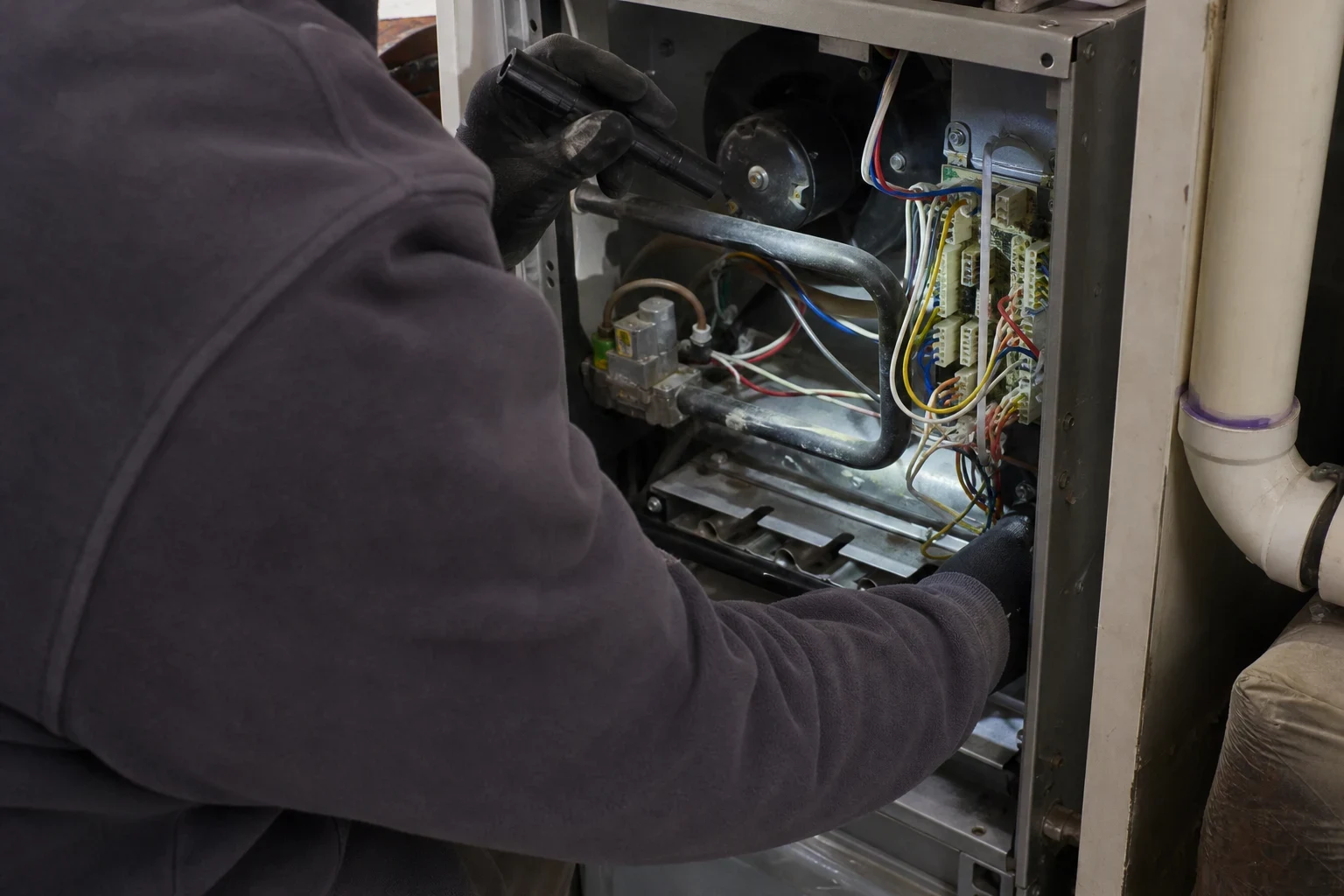
Most gas furnaces fail in a predictable order. The thermostat calls for heat, the inducer motor clears the flue, the pressure switch confirms the draft, the igniter heats, the gas valve opens and the flame sensor proves the flame. If any step fails, the control board shuts things down and usually flashes a code. Our job is to find which step broke and why.
That second part matters. A flame sensor coated with oxidation can be cleaned in minutes, but if it fouled because of a cracked burner or poor combustion air, it will fail again. We tell you the cause, the fix and whether the furnace is worth repairing. If it is not, we say so plainly and explain your furnace installation options without pushing them.
What we check and fix
Ignition and flame sensing
We test hot surface igniters for resistance and cracks, and clean or replace flame sensors that read too weak. These two parts cause a large share of no-heat calls.
Draft and safety switches
We check the inducer motor, pressure switch tubing and high limit switch. A tripped limit usually points to restricted airflow, often a clogged filter or a failing blower, so we look for that cause too.
Blower motor and capacitor
A weak run capacitor can leave the blower humming without turning. We measure capacitance, check motor amperage and inspect the blower wheel for dust buildup.
Gas valve and burners
We confirm gas pressure at the valve, inspect burners for rust and misalignment and check that the flame is steady and blue.
Control board and wiring
We read fault codes, check low-voltage wiring from the thermostat and test the board before replacing it, since boards are expensive and often blamed for problems elsewhere.
Heat exchanger and venting check
Every visit includes a look at the heat exchanger and flue connections, along with a carbon monoxide reading, because a cracked exchanger is a safety issue, not just a comfort one.
Signs your furnace needs repair
Blowing cold air
The blower runs but the burners never light or shut off quickly. This often traces to a fouled flame sensor or a failed igniter.
Short cycling
The furnace starts, runs a few minutes and stops. Overheating from poor airflow, a bad limit switch or an oversized unit are common causes.
Clicking with no flame
Repeated clicking usually means the igniter or gas valve is not doing its job, and the board locks out after several tries.
Loud bangs or squeals
A bang at startup can mean delayed ignition from dirty burners. A squeal usually points to blower motor bearings on their way out.
Yellow flame or CO alarm
A lazy yellow flame suggests incomplete combustion. If your carbon monoxide alarm sounds, leave the house, call the gas utility and then call us.
How a repair visit runs
- 1
You call and describe it
Tell us what the furnace is doing and any code you see blinking. That helps us bring the likely parts on the truck.
- 2
We diagnose
Our technician tests the sequence of operation step by step until the failure shows itself. Once you approve the repair, what you paid for the diagnosis comes off the repair total.
- 3
Written quote first
You get a written quote naming the part, the labor and the reason it failed. Nothing gets replaced until you approve it.
- 4
Repair and verify
We make the repair, then run the furnace through several full cycles while we check temperature rise, flame quality and combustion readings. We wipe down the cabinet, haul off the old part and show you what we replaced.
What moves the price of a furnace repair
Repair cost comes down to which part failed, how hard it is to reach and whether we can get it right away. We explain each line on the written quote so you can see where the money goes.
- The part itself
- A flame sensor or igniter is a small part. An inducer motor, gas valve or control board costs considerably more.
- Brand and age
- Common parts for newer furnaces are easy to source. Older or less common models may need specific manufacturer parts that take longer to get.
- Access
- A furnace in a tight crawlspace or cramped attic takes more labor than one in an open basement or garage.
- Underlying cause
- If a part failed because of something else, such as a weak blower or a restricted filter, fixing both costs more now but prevents a repeat visit.
Furnace repair questions
Something not covered here? (509) 398-9080
Should I repair my furnace or replace it?
If the heat exchanger is sound and the repair is a single part, repair usually makes sense. When a furnace is near the end of its life and needs a major part like an inducer or heat exchanger, replacement can be the better value. We give you both numbers and our honest read.
Do you charge extra for nights or weekends?
No. We have no emergency or after-hours fees, so a repair at 2 a.m. in January is priced the same as one on a weekday afternoon.
Is your work warrantied?
Yes. We offer a 1-year labor warranty on all repairs. Manufacturer parts warranties depend on the part and the brand, and we tell you what applies.
What credentials do you carry for gas furnace work?
We are licensed and bonded in Washington and carry $1M general liability insurance. That coverage applies to the work we do in your home.
Can I do anything before you arrive?
Check that the thermostat is set to heat, the furnace switch is on and the filter is not clogged. Cleaning a flame sensor yourself is possible, but if the furnace keeps locking out, the cause is often deeper.
Do you work outside Rosalia?
Yes. We handle furnace repair across the area, including Cheney, Colfax, Spokane, Airway Heights, Medical Lake and Fairchild AFB.
A warm house starts with the right diagnosis
Describe the symptoms over the phone and we will send a technician to trace the cause. The price goes in writing before any part is swapped.